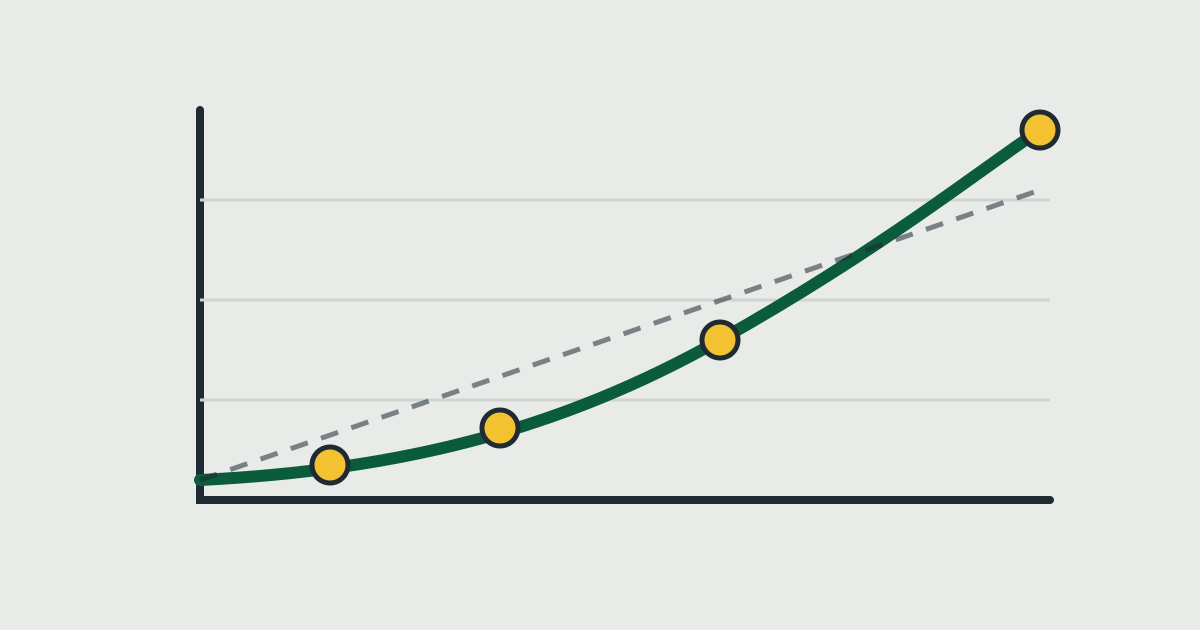
Riegel’s formula predicts a race time at a new distance from a recent result: new time = recent time × (new distance ÷ recent distance)^1.06. A 25:00 5K predicts a 52:07 10K. It predicts a 3:59:47 marathon, which is optimistic for many runners.[2]
How Riegel’s formula works
Peter Riegel, an engineer and marathoner, published the formula in a 1981 article in American Scientist.[1] Its exponent, 1.06, captures the way pace slows as distance grows. Doubling the distance multiplies the time by 21.06, which is 2.08, so a 25:00 5K predicts a 52:07 10K, not 50:00. The calculation uses your recent time and the two distances. It uses nothing else about you.
Where it works and where it runs fast
- Range. Riegel described the formula for efforts of roughly 3.5 to 230 minutes.[3] A slow marathon lasts longer than that.
- Up to the half marathon. In a 2016 study of 2,303 recreational runners, the formula was well calibrated for races up to a half marathon.[2]
- The marathon. The same study found it dramatically underestimated marathon times, giving times at least 10 minutes too fast for half of the runners.[2] If you predict a marathon, add a buffer and base it on a recent half marathon where you can.
- Other factors. In that study, sex, age, body mass index and race training were all associated with race speed.[2] A formula that uses one race time cannot see them.
- Conditions. A prediction assumes similar courses, weather and training for the new distance.
How to use a prediction
Treat the result as a starting point for a goal, not a promise. To turn a goal time into pace and splits, use the 5K, 10K, half marathon or marathon pace calculator. To get training paces from a result, use the training pace calculator. To see your current pace from a result, use the mile pace calculator.
To find your own exponent from two results, use the Riegel exponent calculator or read Riegel’s formula and your personal exponent.
Frequently asked questions
What is Riegel’s formula?
Riegel’s formula predicts a time at a new distance from a recent time: T2 = T1 × (D2 ÷ D1)^1.06. The exponent 1.06 means a runner slows slightly as the distance grows, so doubling the distance takes about 2.08 times as long, not 2 times.
How accurate is the race time predictor?
It was well calibrated up to the half marathon in a 2016 study of 2,303 recreational runners. For the marathon, it gave times at least 10 minutes too fast for half of the runners. Treat a marathon prediction as an optimistic estimate.
Can I predict a marathon time from a 5K?
You can, but the longer the jump, the less reliable the result. A 5K prediction for the marathon assumes you are trained for 26.2 miles. Use a recent 10K or half marathon if you have one.
Sources
- Riegel, P.S. (1981). Athletic records and human endurance. American Scientist, 69(3), 285–290.
- Vickers, A.J. and Vertosick, E.A. (2016). An empirical study of race times in recreational endurance runners. BMC Sports Science, Medicine and Rehabilitation.
- Peter Riegel, Wikipedia, which summarizes Riegel’s 1981 article and the 3.5 to 230 minute range.