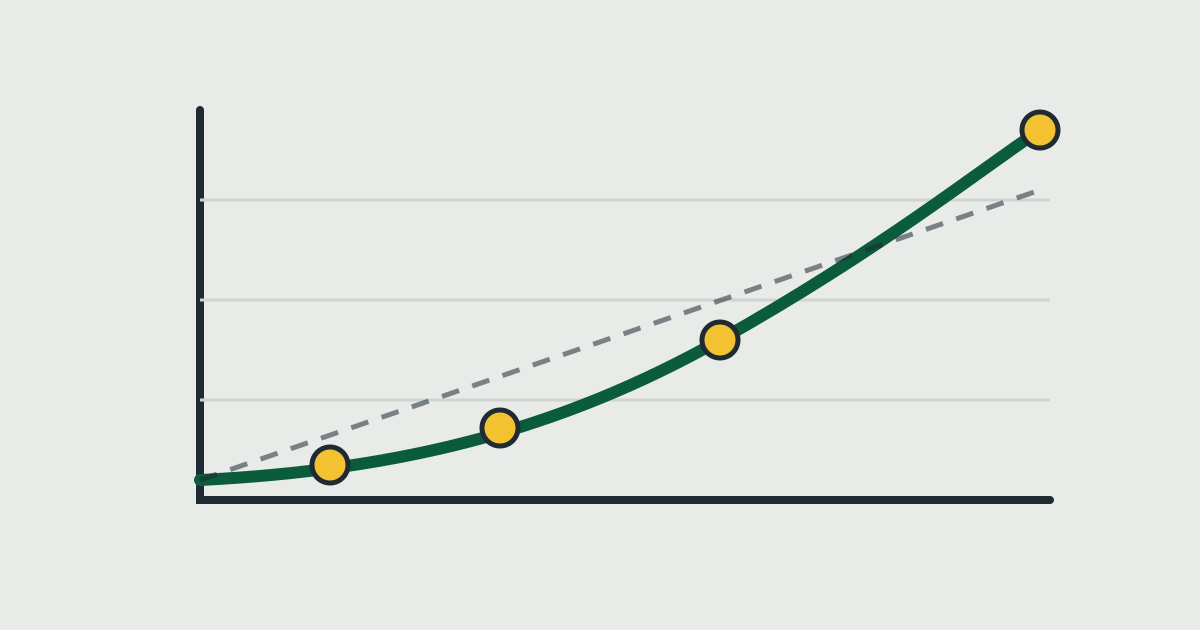
Your Riegel exponent comes from two race results: exponent = ln(T2 ÷ T1) ÷ ln(D2 ÷ D1). A 25:00 5K and a 52:30 10K give 1.07, slightly above the standard 1.06. With that exponent the 5K result predicts a 1:56:44 half marathon, against 1:55:00 with 1.06.[1]
How the calculator works
Riegel’s formula predicts a new time as T2 = T1 × (D2 ÷ D1)^e, with a standard exponent of 1.06.[1] If you know two results, you can solve for the exponent that fits them exactly. The calculator does that, then uses the resulting power curve to predict other distances. Because the curve passes through both of your results, it reproduces them, and it differs from the standard prediction everywhere else.
Worked example
Take a 25:00 5K and a 52:30 10K. The time ratio is 3,150 ÷ 1,500 = 2.10 and the distance ratio is 2. The exponent is ln(2.10) ÷ ln(2) = 1.070. The table shows predictions from the 5K result with that exponent and with 1.06.
| Distance | Your exponent (1.07) | Standard 1.06 | Difference |
|---|---|---|---|
| 1 mile | 7:26 | 7:31 | −0:05 |
| 5K | 25:00 | 25:00 | 0:00 |
| 10K | 52:30 | 52:07 | +0:23 |
| 10 miles | 1:27:22 | 1:26:19 | +1:03 |
| Half marathon | 1:56:44 | 1:55:00 | +1:44 |
| Marathon | 4:05:09 | 3:59:47 | +5:22 |
How sensitive the exponent is
An exponent based on two results moves when either time moves. This table keeps the 25:00 5K and changes the 10K time by up to 60 seconds, then predicts a marathon with each exponent. A change of one minute in the 10K shifts the marathon prediction by several minutes, which is why the result needs two honest, all-out efforts.
| 10K time | Exponent | Predicted marathon |
|---|---|---|
| 51:30 | 1.043 | 3:51:04 |
| 52:00 | 1.057 | 3:58:02 |
| 52:30 | 1.070 | 4:05:09 |
| 53:00 | 1.084 | 4:12:24 |
| 53:30 | 1.098 | 4:19:48 |
When to trust it
- Two full-effort results run in similar conditions and close in date. A tired or hot race gives a misleading exponent.
- Distances near your two races. Predictions outside the range are marked †.
- Riegel’s range. He described the formula for efforts of roughly 3.5 to 230 minutes.[3]
- The marathon. In a 2016 study of 2,303 recreational runners, the standard formula gave marathon times at least 10 minutes too fast for half of the runners.[2] A personal exponent from shorter races does not remove that risk, so add a buffer.
Standard predictor or personal exponent?
If you have one recent result, use the race time predictor. If you have two, this calculator shows how far you are from the standard curve. To turn a prediction into splits, use the marathon pace calculator or another race pace calculator, and to get training paces use the training pace calculator. The guide to Riegel’s formula explains the method in more depth.
Frequently asked questions
What is a Riegel exponent?
It is the fatigue factor in Riegel’s formula. The standard value is 1.06. A higher exponent means your time grows faster with distance than the standard predicts, and a lower one means it grows more slowly.
How do I calculate my own exponent?
Use two race results at different distances: exponent = ln(T2 ÷ T1) ÷ ln(D2 ÷ D1). A 25:00 5K and a 52:30 10K give 1.07.
Is a personal exponent more accurate than 1.06?
It can fit your own pair of races exactly, but it is based on only two results and small time errors move it. Use it for distances near your two races and treat distant predictions with caution.
Sources
- Riegel, P.S. (1981). Athletic records and human endurance. American Scientist, 69(3), 285–290.
- Vickers, A.J. and Vertosick, E.A. (2016). An empirical study of race times in recreational endurance runners. BMC Sports Science, Medicine and Rehabilitation.
- Peter Riegel, Wikipedia, which summarizes the 3.5 to 230 minute range.