Riegel’s formula: predict race times and find your exponent
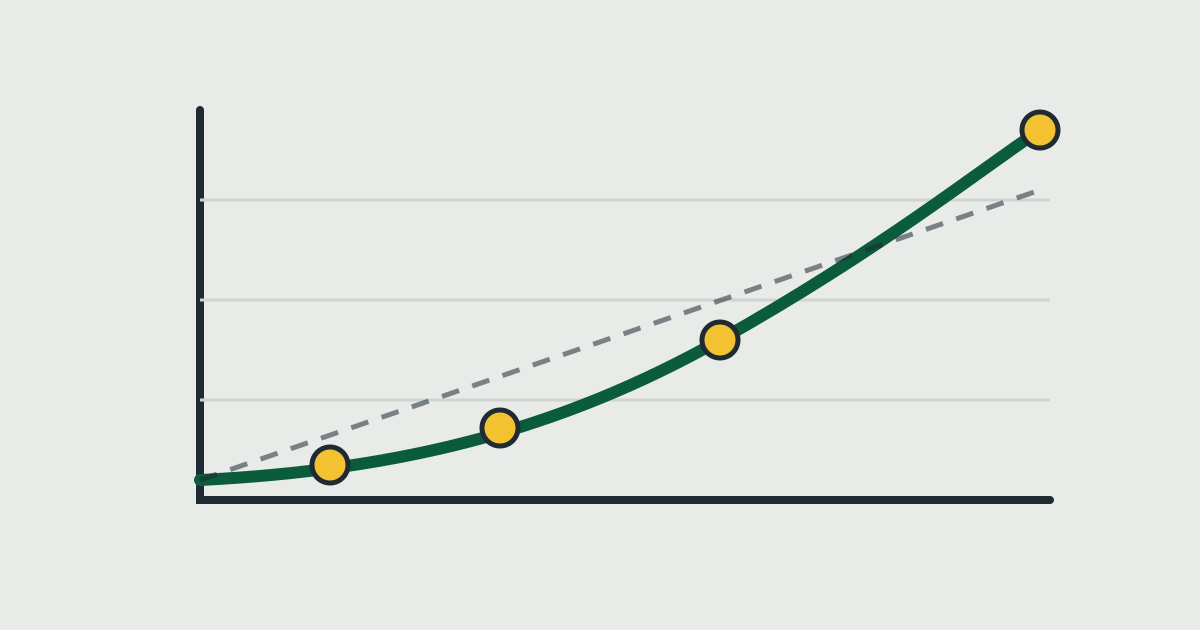
Riegel’s formula predicts a time at a new distance: new time = recent time × (new distance ÷ recent distance)^1.06. The exponent 1.06 is the fatigue factor. You can calculate your own from two races: exponent = ln(time 2 ÷ time 1) ÷ ln(distance 2 ÷ distance 1).
The formula
Peter Riegel, an engineer and marathoner, published his endurance equation in a 1981 article in American Scientist.[1] The formula is T2 = T1 × (D2 ÷ D1)^1.06, where T1 is a known time, D1 its distance and D2 the distance to predict. The exponent describes how much you slow as the distance grows. An exponent of 1.00 would mean the same pace at every distance. At 1.06, doubling the distance multiplies the time by 2.08. According to a later study, the formula comes from an analysis of world record times across several endurance sports.[2]
Where it works
Riegel described it for efforts of roughly 3.5 to 230 minutes.[3] In a 2016 study of 2,303 recreational runners, it was well calibrated for races up to a half marathon. It gave marathon times at least 10 minutes too fast for half of the runners.[2] For a marathon prediction, use it with a buffer. The race time predictor shows all distances at once, and the Riegel exponent calculator finds your own exponent from two results.
How to calculate your own exponent
If you have two recent results at different distances, solve the formula for the exponent: e = ln(T2 ÷ T1) ÷ ln(D2 ÷ D1).
Example 1. A 25:00 5K and a 52:30 10K. The time ratio is 3150 ÷ 1500 = 2.10, and the distance ratio is 2. e = ln(2.10) ÷ ln(2) = 1.07.
Example 2. The same 52:30 10K and a 1:55:00 half marathon. The time ratio is 6900 ÷ 3150 = 2.19, and the distance ratio is 21,097.5 ÷ 10,000 = 2.11. e = ln(2.19) ÷ ln(2.11) = 1.05.
Your exponent can differ from 1.06 and can change with the distance pair you use. Use it only to predict distances close to the two you measured.
Why the exponent matters
A small change in the exponent changes a long-distance prediction a lot. This table predicts a marathon from a 52:30 10K. The last column shows the difference from the standard 1.06.
| Exponent | Predicted marathon | Versus 1.06 |
|---|---|---|
| 1.04 | 3:54:39 | −6:51 |
| 1.06 | 4:01:31 | reference |
| 1.08 | 4:08:34 | +7:03 |
| 1.10 | 4:15:50 | +14:19 |
The table is arithmetic, not a claim about which exponent suits which runner.
What a single-race prediction cannot see
In the 2016 study, sex, age, body mass index and race training were all associated with race speed.[2] A formula that uses one race time cannot account for them. Use predictions to choose a goal, then confirm it with training. To turn the goal into splits, see the marathon pace calculator.
Frequently asked questions
What is the 1.06 in Riegel’s formula?
It is the fatigue exponent. It means a runner slows slightly as distance increases, so doubling the distance takes about 2.08 times as long.
How do I find my own Riegel exponent?
Use two results: exponent = ln(T2 ÷ T1) ÷ ln(D2 ÷ D1). A 25:00 5K and a 52:30 10K give about 1.07.
Is Riegel’s formula accurate for the marathon?
Not always. In a 2016 study of recreational runners it gave marathon times at least 10 minutes too fast for half of the runners, so add a buffer.
Sources
- Riegel, P.S. (1981). Athletic records and human endurance. American Scientist, 69(3), 285–290.
- Vickers, A.J. and Vertosick, E.A. (2016). An empirical study of race times in recreational endurance runners. BMC Sports Science, Medicine and Rehabilitation.
- Peter Riegel, Wikipedia, summarizing the 3.5 to 230 minute range of Riegel’s formula.
Related tools and guides

About the author
Shaheer Bin Ramzan is a software engineer and SEO specialist with five years of professional experience. He builds and checks the calculators and writes the guides on MilePaceLab. He is not a running coach or doctor. See the author page, the methodology and the disclaimer. Report errors through the contact page.